

What the Elvie-Willow Deal Really Means for the Future of Femtech
A candid look at the risks, realities, and road ahead for women’s health innovation.

This isn’t our usual newsletter. Today’s issue breaks down one of the most significant shakeups in femtech to date: Willow’s acquisition of Elvie, a distressed sale that reveals deeper fault lines across the women’s health innovation landscape.
FemmeHealth Ventures Alliance is your trusted source for investor-grade insight into women’s health technology. Here’s what this deal tells us and what’s at stake.
If this email was forwarded to you, you have awesome friends. Click below to join. Don’t forget, you can always explore our archives to catch up on any past stories.
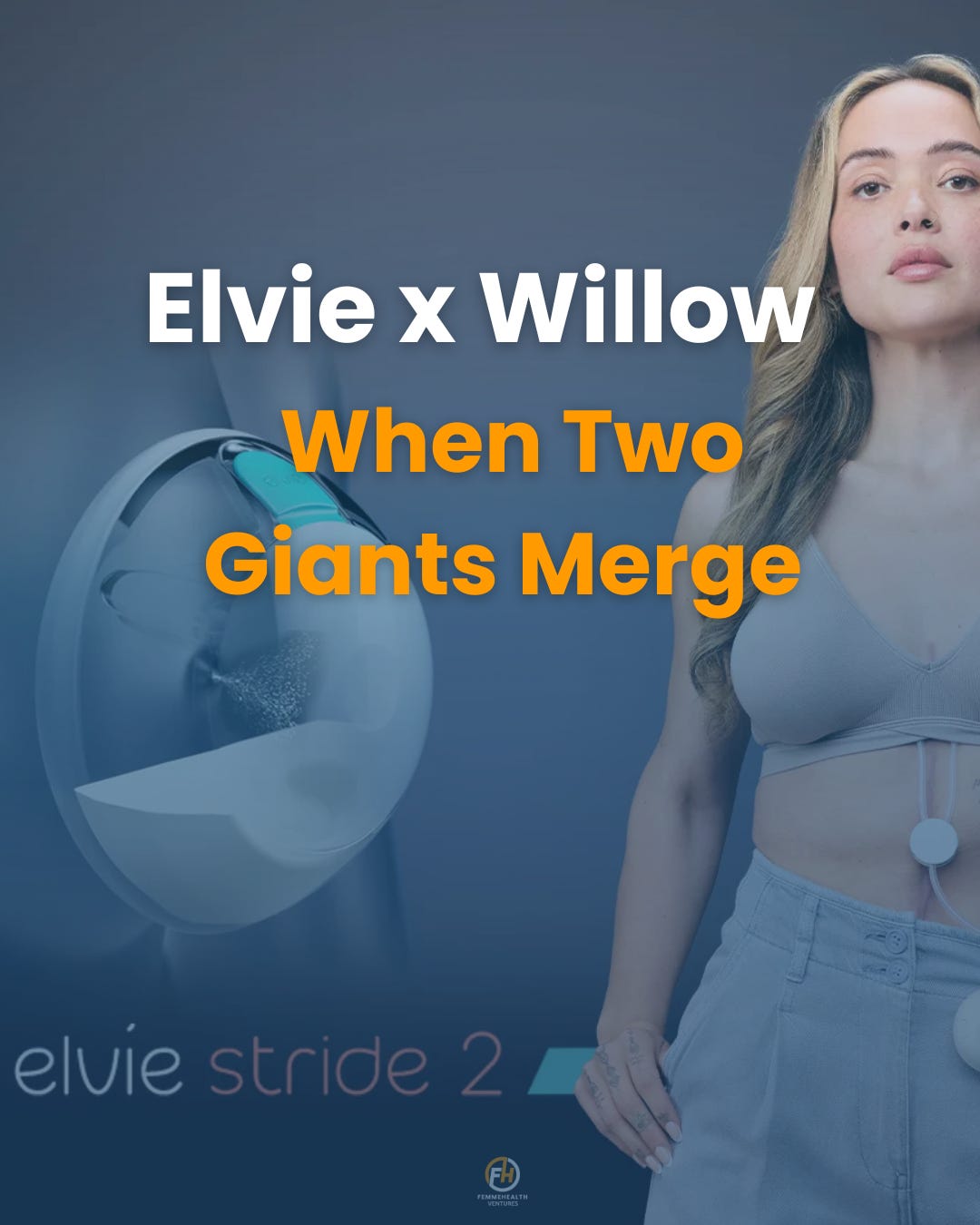
Elvie x Willow: When Two Giants Merge, What Does Femtech Risk Losing?
When the news broke that Willow had acquired Elvie, the reaction across femtech was mixed: relief, nostalgia, curiosity and concern. Two of the best-known names in women’s health tech, once rivals, now united under one banner.
But dig beneath the headlines, and the deal reveals deeper truths about where the Femtech sector stands, what it’s up against, and where it could go next.
Not a Victory Lap But Not a Failure Either
Elvie wasn’t acquired at the peak of its powers. It was in administration. A distressed sale. But that doesn’t make this a failure. It makes it real. The reality is that Femtech, despite a $60B addressable market, still struggles with scale, exits, and capital access. Willow stepped in to preserve value, not just for itself, but for the category.
This was a rescue, but also a bet.
Femtech’s Maturation Moment
Consolidation is a natural phase in any industry. It signals that the market is maturing. We are no longer in the “crowdfunding and concept” stage of femtech. We are in the platform-building era. Willow clearly sees an opportunity to aggregate products, talent, and IP and become a category anchor.
In a space with limited IPO or acquisition pathways, maybe that’s exactly what we need: a scaled player making its own platform.
But here’s where fragility enters: if consolidation replaces innovation, if scale crushes diversity, then what we gain in power we may lose in purpose.
Hardware Is Hard. Femtech Hardware Is Even Harder.
The Elvie story also underscores a hard truth: hardware is brutal. Especially in women’s health.
You need clinical validation, consumer trust, retail distribution, and reimbursement pathways all while margins stay razor-thin.
That Elvie lasted 12 years, raised nearly $200M, and became a household name is a feat in itself. But even that wasn’t enough.
Many femtech hardware companies face similar challenges. Long R&D cycles. Complicated regulatory paths. High upfront costs. And no clear bridge to profitability. This is one of the most fragile parts of the sector.
A Caution for Capital
Let’s be honest: Elvie did what many venture-backed startups are told to do:
Grow fast
Build brand equity
Expand product lines.
Yet when it needed late-stage capital, it found none. This wasn’t just a company problem; it was a capital stack problem.
There is a disconnect between early-stage enthusiasm for femtech and the follow-through required to build enduring, profitable companies. Investors love the pitch. They need to learn to love the path.

What Happens Next Will Matter More Than the Deal Itself
The true story of this acquisition will be written in the next 18–24 months:
Will Willow successfully integrate the Elvie team and product line?
Will it invest in innovation or simply coast on consolidation?
Will the femtech community rally behind a stronger platform or fragment further?
If Willow can scale profitably without losing sight of why femtech exists in the first place, to innovate meaningfully for women’s health, then this acquisition may prove to be a smart, even pivotal, move.
But if consolidation leads to stagnation, it will confirm our worst fears: that even when femtech wins, it loses its edge.
What Willow Could Do Right Now
Keep Elvie’s product identity and brand distinct rather than folding it under a generic umbrella.
Expand the platform beyond postpartum care; think menopause, cardiovascular health, autoimmune disorders.
Double down on reimbursement, insurance, and healthcare partnerships to protect margins.
Retain Elvie’s design ethos and team where possible, ensuring the user experience remains intuitive and empathetic.
Final Thoughts
The Elvie–Willow deal isn’t just a sign of change. It’s a test.
We often say Femtech is maturing. But maturity isn’t measured by consolidation alone. It’s measured by the sector’s ability to turn strong products into sustainable businesses, and early excitement into long-term value.
If Femtech is to scale, it needs sharper execution, more focused capital, and platforms built with both consumer insight and commercial strategy.
This deal shows what’s possible, but also what’s at stake. The next chapter will be defined by those who can build with both conviction and clarity.

Ways to Connect with FemmeHealth Ventures Alliance
Thanks for reading. If you liked what you read, consider:
signing up for FemmeHealth newsletter, which is published weekly
sending to a friend or co-worker

Disclaimer
The content in this newsletter is for informational purposes only and does not constitute financial, investment, legal, or medical advice. Opinions expressed are those of the author and may not reflect the views of affiliated organisations. Readers should seek professional advice tailored to their individual circumstances before making decisions. Investing involves risk, including potential loss of principal. Past performance does not guarantee future results.
"But here’s where fragility enters: if consolidation replaces innovation, if scale crushes diversity, then what we gain in power we may lose in purpose.".... Great example of why I love your work!
I felt like this news was pretty quiet so thanks for sharing it. I felt a pang of sadness as an Elvie pump user 5 years ago. I liked the design better than Willow and I hope they keep it to maintain options for women!