

The Quiet Defunding of Care
What Title X Tells Us About Who Deserves Health

Welcome to the latest edition from FemmeHealth Ventures Alliance. Delivering strategic insights into women’s health innovation and investment.
This edition is part of our reflective series: From the Archives of Care — narrative essays that explore the historical and cultural roots of today’s health policy decisions. These pieces offer a wider lens on the systems we invest in and the care we fight for.
If this email was forwarded to you, you have awesome friends. Click below to join. Don’t forget, you can always explore our archives to catch up on any past stories.
On a humid August afternoon in 1970, President Richard Nixon signed a bill that barely registered on the front pages. There were no parades, no marches, no sweeping speeches. Yet tucked inside the Public Health Service Act was Title X—a quietly revolutionary commitment:
No American woman should be denied access to family planning because of her economic status. — President Richard Nixon, 1970

Clinics would open in underserved neighborhoods, offering birth control, STI testing, cancer screenings, and basic preventive care. And for millions, it would become the only form of health care they would ever receive.
More than 50 years later, the silence is back, but this time, it's not protective. It's strategic.
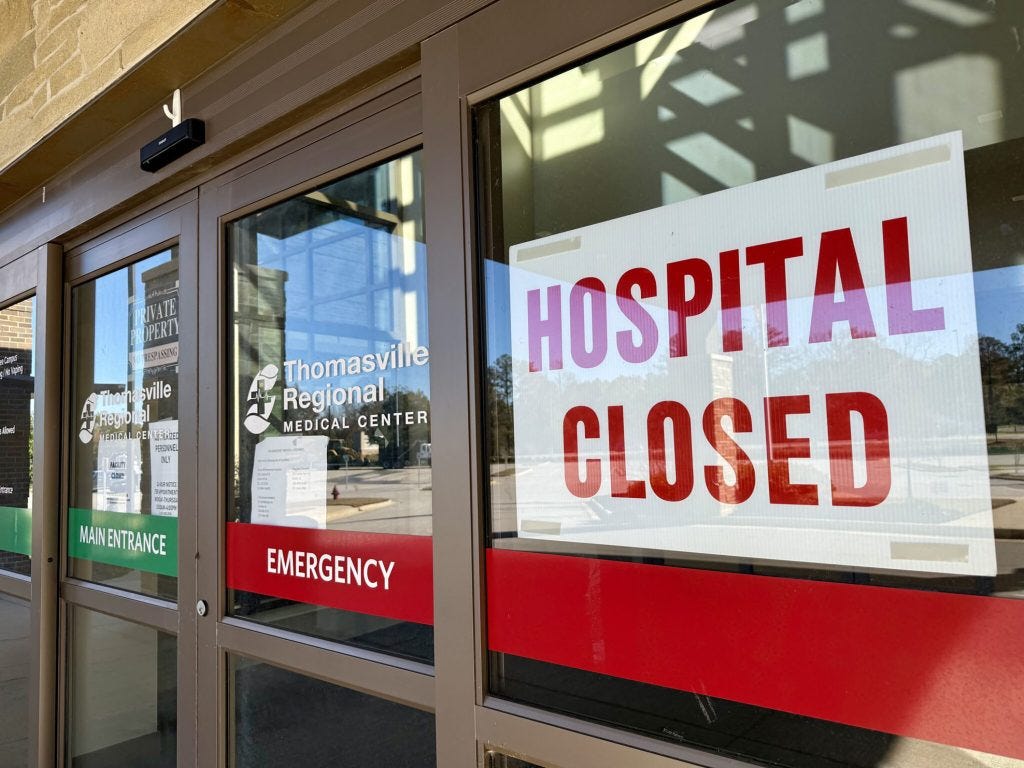
Last week, the U.S. Department of Health and Human Services announced it would withhold $65.8 million in Title X funds from 16 health organizations serving patients across 23 states. No laws were passed. No headlines screamed. But for the 846,000 low-income patients depending on those clinics, the consequence is loud and immediate: canceled appointments, shuttered doors, and a devastating question—where will I go now?
What It Reveals
This isn’t just about reproductive health. It’s about who we deem worthy of care.
Though Title X has never funded abortion services, its very proximity to reproductive freedom has made it a political target. And the Trump-era Executive Order now cited to justify the freeze is clear: undocumented immigrants are not entitled to taxpayer-funded care.
But the freeze doesn’t just affect immigrants. It sweeps broadly, hitting Planned Parenthood clinics, rural health centers, and mobile units serving entire islands in Hawaii and remote villages in Alaska.
The message is both chilling and familiar: health is not a right, but a reward.
And access is conditional. Granted only to those whose identities, citizenship status, and affiliations align with the state’s current political mood.
It’s a bureaucracy of exclusion. A defunding dressed in compliance. A policy where the paperwork is the punishment.
There is no clearer demonstration of this than Missouri, where voters recently passed a ballot measure enshrining abortion rights into the state constitution. Yet despite that democratic mandate, the state’s only Title X grantee—Missouri Family Health Council—has had $8.5 million frozen. Executive Director Michelle Trupiano says clinics are weeks away from closing. Sliding fee scales are vanishing. And “business as usual” is no longer viable.
“We’re already on shoestring budgets,” she says. “Now we’re being asked to survive on no string at all.”
The Legacy
This moment is not new. It is part of a larger erosion.
In 2019, the Trump Administration imposed what became known as the “domestic gag rule” prohibiting Title X recipients from even referring patients for abortion care. Many providers, including Planned Parenthood, withdrew from the program. Access plummeted. By 2020, the Guttmacher Institute estimated that 2.4 million fewer people received Title X services than in 2018.
Though the Biden Administration repealed the gag rule in 2021, the infrastructure had already been weakened, and in some cases, collapsed. States like Alaska never fully recovered. Planned Parenthood of the Great Northwest, Hawai’i, Alaska, Indiana, and Kentucky (PPGNHAIK) says they serve the majority of Title X patients in those regions. Today, their funding is gone.
The freeze cuts across politics. Blue states like California and Maine are affected alongside red states like Mississippi and Utah. Laws that enshrine abortion access are not shields against funding decisions made in Washington.
As Rep. Judy Chu of California put it:
“There are other ways to undermine reproductive health. This is one of them.”
And the consequences aren’t abstract. In Hawaii, one island has no Title X-funded clinic at all. In Maine, the sole Title X provider—Maine Family Planning—has lost 20% of its operating budget overnight. In Alaska, remote communities served by mobile clinics now face the possibility of no care at all.
We are watching, in real time, the creation of reproductive health deserts where legality exists without access, and rights without resources.
Today’s Disruptors
Still, the story does not end with closure. In the cracks, people are building.
Planned Parenthood Michigan, anticipating this funding threat, made a painful decision: to permanently close three clinics and consolidate two more. But alongside that, they are expanding virtual services, offering birth control, medication abortion, and gender-affirming care seven days a week, remotely.
Maine Family Planning is relying on private donations and pushing for state-level support. In Alaska, health workers are working overtime to triage care and delay closures. And across the country, founders and investors in women’s health are stepping into the breach backing innovations in telehealth, AI diagnostics, and mobile delivery models.
They are not just resisting. They are rewriting the care map.
These are the disruptors who believe that access should not be rationed by politics, nor constrained by ZIP code. Their work is a quiet rebellion against a louder erosion.
But even they acknowledge: there is only so much private capital can solve. When federal infrastructure is deliberately dismantled, philanthropy becomes triage. And the communities left behind often rural, immigrant, and low-income carry the cost.
In 1970, Title X wasn’t just a funding stream. It was a declaration. A bipartisan belief that basic care was not a luxury, but a public good.
Today, that idea is under siege, not with fire and fury, but with freezes and forms. The architecture of reproductive health in America is being quietly pulled apart, brick by brick, until only the illusion of access remains.
We often imagine historical regression as a sharp event. But sometimes, it’s a slow fade, an incremental narrowing of the lanes through which people can survive, plan, and thrive.
What makes this moment especially stark is that care hasn’t disappeared all at once. It’s still there, for those who can afford it. For those in the right states. For those with the right paperwork. That’s what makes it more insidious: it doesn’t look like injustice. It looks like eligibility criteria.
But a nation’s values are never more visible than in who it decides to care for when no one is looking. So here we are again, standing at the edge of an old question, newly urgent:
Who deserves care? And who decides?
With love and resolve,

Sources
Guttmacher Institute. “Trump Administration’s Withholding of Funds Could Impact 30% of Title X Patients” Guttmacher Policy Review, April 2025.
National Family Planning & Reproductive Health Association (NFPRHA)
TIME Magazine. Lee, Chantelle. “Trump Administration Freezes Critical Title X Funding for 16 Organizations.” TIME, April 3, 2025
Planned Parenthood Federation of America. “PPFA Responds to Title X Funding Withholdings.” March 2025.
Rep. Judy Chu – Press Release Urging Reinstatement of Title X Funding
Kaiser Family Foundation (KFF). A New Reproductive Health Landscape
Ways to Connect with FemmeHealth Ventures Alliance
Thanks for reading. If you liked what you read, consider:
signing up for FemmeHealth newsletter, which is published weekly
sending to a friend or co-worker
Disclaimer & Disclosure
This content is for informational and educational purposes only. It does not constitute financial, investment, legal, or medical advice, or an offer to buy or sell any securities. Opinions expressed are those of the author and may not reflect the views of affiliated organisations. Readers should seek professional advice tailored to their individual circumstances before making investment decisions. Investing involves risk, including potential loss of principal. Past performance does not guarantee future results.
Terrific well-research post, as always. And it's all correct. Yes, the US refuses to decide if basic healthcare is a right or a privilege, although with 60% of our citizens now covered by Medicaid, Medicare or Obamacare, I’d argue we’ve been deciding that passively, with a major storm on that coming this summer. But this particular move is also deeper and uglier. The US has a record low birthrate that keeps dropping. (Low birth rates are always economically rooted, a longer discussion than this comment.) US conservatives have always been against abortion and birth control generally, but what's new now is the economic impact of the falling birth rate. In the US, we're missing at least 12 million births since the 2008 recession. The oldest of those kids would have turned 16 in 2024, eligible for military enrollment and employment, both of which were already in trouble with historically low unemployment (~4%). Historically, immigrants have always backfilled our birth rates and taken low paying jobs White Americans won’t, and now we are aggressively removing immigrants, with a White House goal of deporting a million in 2025. (Also no time in this comment to talk about the inability of either party to tackle immigration wisely.) And while DC has been laying off droves of staff, those laid off are well-educated; they’re not going to do farm or manufacturing work. Add in outsourcing of US manufacturing to cheaper wage countries prior to all this, and you have the perfect storm for a Christian nationalist-fronted, economically motivated pronatal movement that's now out in the open. JD Vance, Hegseth and influential Tech Bros like Musk and Altman are all proponents, along with independently wealthy families like the couple in the attached WSJ video. It’s one thing for them to have a dozen kids: it’s another for the vast majority of American families—with both parents having to work to make a decent income. (Too long here also to talk about the impact of Trump’s tax cut on the middle class.) The WSJ—not noted for a liberal viewpoint—describes all this well in the attached YouTube video. Here's where things get ugly about your post: While the administration will talk about how this saves costs, and celebrate with conservative Christian voters, the impact of this—as you note—is targeted to poor women. From experience and reams of multi-country long-term data, we—those of us in healthcare and policy, and definitely these politicians— absolutely know that there will be two clear results: increased births among poor women, and that those births will consign them to a lifetime of poverty they might otherwise have escaped. And the latter ultimately means more low wage workers, another benefit to many of the odd bedfellows in the pronatal movement. And that’s why this is a far uglier question than ‘just’ denying healthcare to women. We live for the simple: it’s so much easier to punish people than to deal with the well-documented socio-economic issues that underwrite the decisions everyone makes every day—including every single childbearing age family in America.
https://www.youtube.com/watch?v=dx3NjGSrpQ8
I’ve been a little tuned out the last few weeks as I’ve been traveling and now in a blue state. And I’m one of those ones that keep saying, we should not be surprised at the next idiotic insane thing this administration does to dismantle our society. And yet hearing this, makes it so hard to live by my own words. So basically it sounds like people are being forced out of the Ruhl areas either by the farms that are going to be shutting down or cause they cannot get the healthcare. They need to are already mostly overcrowded cities. Where disease and crime are higher because when you start shoving more people in a smaller area, those are things that go up. Which makes everybody again easier to control. How can I help with my work?