

The Cost of Waiting: Why Women’s Health Delays Are a Trillion-Dollar Problem
Diagnosis shouldn’t take a decade. The market opportunity hiding in plain sight.

Welcome to the latest edition from FemmeHealth Ventures Alliance — delivering strategic insights into women’s health innovation and investment. We help you track emerging opportunities in Femtech and beyond, through a disciplined investor lens.
If this email was forwarded to you, you have awesome friends. Click below to join. Don’t forget, you can always explore our archives to catch up on any past stories.
TL;DR Takeaways:
Delay is not neutral. It’s a form of structural harm.
Diagnostics are the next infrastructure layer in women’s health.
Trust will be the ultimate growth metric.
The waiting room is the market. And it’s enormous.
The Pattern of Dismissal
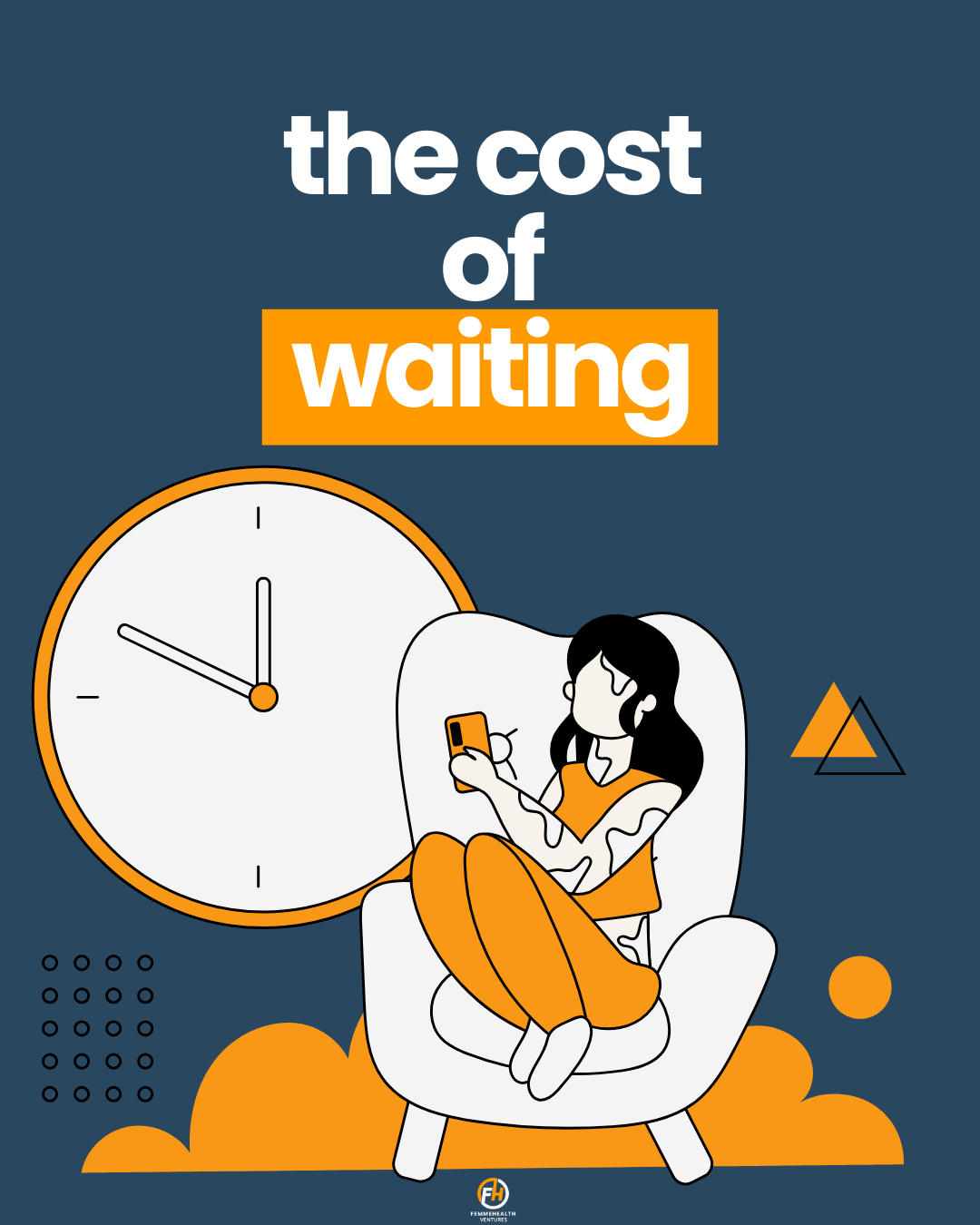
A woman sits in a white room, legs crossed, eyes on the clock. She’s been here before. Different symptoms. Different doctor. Same feeling. Something’s not right, but no one’s listening.
She’s told to wait.
For blood work. For referrals. For her pain to become “bad enough.” She’s told it’s normal. Maybe stress. Maybe perimenopause. Maybe it’ll go away.
This is not a glitch in the system. It is the system.
A system that tolerates delay because it was never built for her urgency.
Why This Matters
I write this as an investor who backs health and lifesciences innovation, and as a woman who’s watched friends, colleagues, and founders lose months, years, even decades in a medical maze of delayed diagnoses and unmet care.
Women’s health is not a niche. The suffering is not anecdotal. The delay is not accidental.
In venture, we talk about ‘painkillers vs. vitamins’—the difference between solving urgent needs vs. nice-to-haves. But what happens when the pain is misdiagnosed or completely ignored?
Startups that close this diagnostic gap won’t just deliver ROI. They’ll restore trust, save lives, and rebuild a system from the inside out.
But this isn’t just personal. It’s commercial. And the cost of delay is adding up.
The Evidence: Delay Is Everywhere
Let’s look at the data:
Endometriosis affects 1 in 10 women, but it takes 7–10 years on average to diagnose. ¹
Polycystic Ovary Syndrome (PCOS) impacts up to 13% of reproductive-age women globally and 70% go undiagnosed. ²
Women with autoimmune conditions often see four or more doctors over nearly five years before getting a correct diagnosis. ³
Even in acute settings, bias persists: A 2019 Journal of Pain study found women are less likely than men to be prescribed painkillers for the same reported symptoms. ⁴
The result is a system that delays care until it’s expensive, invasive, or too late.
And the ripple effects go far beyond the exam room.
The Slow Burn: What Delay Reveals About the System
Delays in women’s health aren’t just a function of limited time or overwhelmed providers. They are a design flaw baked into the system, a quiet signal of who is seen as the default patient, and who is not.
When women are told to wait—for answers, for referrals, for recognition—it reveals how deeply the system undervalues their time, their biology, their pain.
And the consequences of delay are wide-reaching:
Physically, it worsens outcomes. Early detection windows close. Conditions advance.
Emotionally, it chips away at confidence and credibility. Many women begin to question themselves.
Financially, it results in missed work, higher treatment costs, and billions in productivity losses.
In fact, the World Bank and WHO estimate USD $1.4 trillion is lost each year due to untreated or under-treated women’s health conditions globally. ⁵
In the U.S. alone, the economic burden of undiagnosed endometriosis is between USD $15,000–USD $34,000 per patient per year. ⁶
This is the slow burn of delay: invisible at first, then all-consuming.
And yet, this slow burn is also the spark.
For founders building better triage systems, earlier diagnostics, or smarter data tools, this is the opening.
We’re not short on talent or tech. What’s missing is belief; belief that this is solvable, scalable, and urgent.
Founders are already building the future but they need capital that sees beyond the surface. They need investors who recognize that diagnostic delay is healthcare’s most solvable and investable inefficiency.
Delay is the most solvable inefficiency in healthcare today.

What Happens Next (And What Investors Should Be Asking)
We are entering a pivotal window. Women’s health innovation is accelerating but it will stall unless we bridge the diagnostic divide.
Here are the questions I believe the smartest investors are asking now:
Can AI close diagnostic gaps or will it replicate existing biases?
Companies like Nabta Health, Elidah, and AOA Dx exemplify how some founders are using data to detect sooner and intervene earlier. But AI is only as good as the data it learns from, and most health data isn’t built for women.What does it take to build trust in a patient journey that has normalized dismissal?
Startups that prioritize empathy, UX, and credibility in women’s health aren’t just building apps. They are re-architecting the healthcare experience.Where are the billion-dollar companies hiding in plain sight?
Every delay hides a latent market: in diagnostics, remote triage, early detection, or even insurance coverage pathways. The biggest exits will come from solving what seems too systemic to change.
Investing in women’s health diagnostics is not about sympathy. It’s about strategy.
It’s about catching the shift before it hits the mainstream. And it’s about recognizing that the most powerful innovation often begins where trust has been broken.
The most transformative companies won’t just treat illness. They’ll rebuild trust in a system that forgot how to listen.
Want More?
I send private briefings focused on education, market trends, and early-stage innovation in health designed to help you better understand the private investing landscape.
👉 Sign up here to join the investor memo list

Sources:
Endometriosis UK. https://www.endometriosis-uk.org
CDC on PCOS. https://www.cdc.gov/pcos/
Autoimmune Association. https://autoimmune.org
Journal of Pain, 2019.
World Bank & WHO. Delivering Health Services for Women & Girls, 2020.
Soliman AM et al. Epidemiology of Endometriosis. JNMI, 2017.
Ways to Connect with FemmeHealth Ventures Alliance
Thanks for reading. If you liked what you read, consider:
signing up for FemmeHealth newsletter, which is published weekly
sending to a friend or co-worker

Disclaimer & Disclosure
This content is for informational and educational purposes only. It does not constitute financial, investment, legal, or medical advice, or an offer to buy or sell any securities. Opinions expressed are those of the author and may not reflect the views of affiliated organisations. Readers should seek professional advice tailored to their individual circumstances before making investment decisions. Investing involves risk, including potential loss of principal. Past performance does not guarantee future results.
What a great piece. It’s so important to highlight the wider impact of the patriarchal system we live in. And put a price on it. It’s infuriating but better out in the open than a hidden cost. Thanks 🙏🏼