

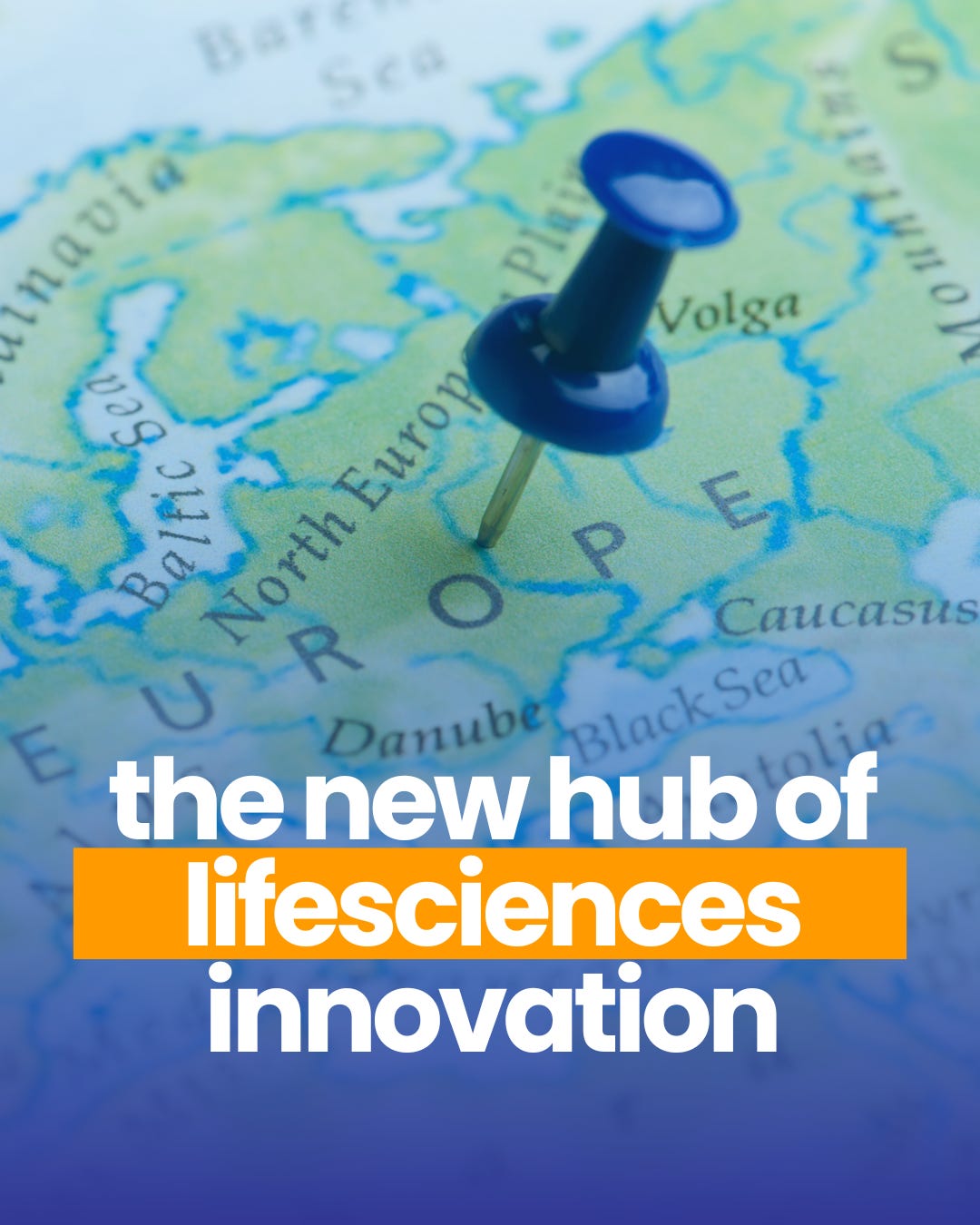
With U.S. Funding Faltering, Europe May Be the Next Hub for Life Sciences Innovation
In the wake of NIH cuts and IPO slowdowns, Europe offers what the U.S. can’t right now: stability and scale.

Welcome to the latest edition from FemmeHealth Ventures Alliance — delivering strategic insights into women’s health innovation and investment. We help you track emerging opportunities in Femtech and beyond, through a disciplined investor lens.
If this email was forwarded to you, you have awesome friends. Click below to join. Don’t forget, you can always explore our archives to catch up on any past stories.
Something is shifting.
For decades, the U.S. was the undisputed nucleus of life sciences innovation—fueled by NIH funding, a robust venture capital ecosystem, and world-class research institutions. Startups thrived in this fertile mix of academic science, private capital, and pharma partnerships.
But that dominance is beginning to wobble.
Federal budget gridlock, growing concerns over fiscal governance, and abrupt leadership changes at agencies like the FDA are unsettling what was once a stable innovation engine. The headlines still highlight biotech breakthroughs but conversations with founders, researchers, and early-stage investors increasingly tell a different story.
Policy volatility is rattling confidence. Regulatory uncertainty is stalling progress. And institutional credibility is eroding.[¹⁰][¹¹][¹²]
The result? Funding flows are tightening, exit paths feel murky, and investor risk appetite is shifting. What once seemed like the safest bet in global biotech now feels precariously reactive. And founders are quietly looking elsewhere for continuity, clarity, and capital.[¹³][¹⁴]
And where there’s uncertainty, there’s opportunity—for Europe.
🇪🇺 Europe’s Moment?
Historically, Europe was rarely the first port of call for healthcare startups. Fragmented regulation, slower-moving capital, and smaller addressable markets kept it a step (or several) behind the U.S. in terms of global biotech leadership.
But something is changing and smart founders are paying attention.
The Horizon Europe programme offers €95.5 billion in R&D funding, making it the world’s largest public research initiative. Countries like Germany, France, the UK, and Switzerland are rapidly scaling grant schemes tailored to biotech and medtech. [¹][²][³][⁴][⁵]
The European Investment Bank and European Innovation Council are actively deploying risk capital into early-stage ventures.[⁶][⁷] And operational costs in hubs like Berlin, Amsterdam, Zurich, and Barcelona remain substantially lower than in Boston or San Diego. [⁸][⁹]
But here’s the nuance: this isn’t a perfect system. Europe still presents meaningful challenges for founders.
Yes, public grant funding is generous, but the application and reporting burden is high.
Yes, regulatory timelines may, going forward, be more predictable than the FDA, but navigating divergent national health authorities still slows reimbursement.
Yes, talent is abundant, but risk tolerance remains lower, and seasoned biotech operators are still more concentrated in the U.S.
In other words: the playing field is levelling, not tipping. And that’s precisely why it’s a moment worth watching.

The Great Repositioning
What we’re seeing is not just a temporary capital rotation.
This could very well become a potential realignment.
As the U.S. wrestles with policy uncertainty and investor caution, Europe is quietly offering something rare in healthcare: predictability.
Founders who once defaulted to Delaware C-corps are now incorporating in Lausanne or Berlin. Some are relocating key hires. Others are setting up dual presences to tap into both EU grants and U.S. commercial scale.
And venture capital is watching.
Because where top talent goes, capital eventually follows.
What Signals Momentum in a European Life Sciences Startup to Investors?
Whether you're pitching your Series A or allocating capital from a family office, the fundamentals haven’t changed, but in Europe, how you signal them absolutely has. These are the patterns investors are watching for—the ones that suggest not just scientific promise, but operational readiness in a complex, fast-evolving ecosystem.
1. Strong Clinical and Preclinical Data
Scientific excellence is the cost of entry. But what separates investable startups is how early they can validate traction. Investors want to see robust preclinical signals, thoughtful trial design, and early proof of real-world relevance.
2. Can You Scale Beyond Borders?
Europe is fragmented but your story shouldn’t be. Whether targeting menopause, autoimmune disease, or oncology, you must articulate how your product can scale across geographies or disrupt existing care pathways. Clarity matters.
3. Regulatory Wins as Strategic Milestones
The EMA offers real advantages when used strategically. A European regulatory path, often faster and more predictable than the FDA, can serve as a powerful de-risking signal. Highlight this early, and align it with your capital roadmap.
4. A Thoughtful Exit Thesis
I am afraid that “we will get acquired eventually” doesn’t land anymore. Founders today need to show how licensing deals, co-development pathways, or public-private partnerships unlock future value. Even if your path evolves, the signal is: we are thinking like capital allocators.
5. Teams That Inspire Confidence and Deliver
Investors don’t just bet on the science. They bet on the people scaling it, especially at the early stage. Diverse, resilient teams that can handle grant compliance, scientific rigor, and investor dialogue signal more than capability. They signal trust. And in European ecosystems, trust travels far.
For Founders: Play the Long Game But Play It Boldly
Europe is not a frictionless ecosystem.
Fragmented reimbursement systems, slower-moving private capital, and more conservative risk profiles still pose real hurdles. But what it does offer right now is momentum, infrastructure investment, and public-sector alignment at a time when the U.S. system feels increasingly gridlocked.
If you are building in women’s health, biotech, diagnostics, or digital therapeutics, this is your invitation:
You don’t have to wait for the U.S. to get its act together. Europe already is.
The smartest founders I know are triangulating between innovation, capital, and credibility. They are applying for EU grants while raising SAFEs. They are building commercialization roadmaps with public health systems before they hit scale. And they are thinking globally even when their tech starts locally.
For Investors: The Blind Spot Is Shifting
The life sciences opportunity isn’t gone. It’s just moved sideways.
The future unicorns may not look like the last cohort, and they may not be based where you are used to looking. But they are solving real problems with real science. And they are doing it in cities that cost less, move faster, and now attract global talent.
The real question is: will you spot them before someone else does?
🟣 At FemmeHealth Ventures, we’re keeping an eye on exactly these shifts especially where women’s health intersects with deep science and capital flows. If you’re building something bold or want to co-invest in this next chapter, let’s talk.
Want More?
I send private briefings focused on education, market trends, and early-stage innovation in health designed to help you better understand the private investing landscape.
👉 Sign up here to join the investor memo list

Sources:
Horizon Europe – The EU Research and Innovation programme (2021–2027)
EIB Investment Report – Life Sciences Sector Overview (2023)
Silicon Valley Bank – Healthcare Investments and Exits Report 2024
Ways to Connect with FemmeHealth Ventures Alliance
Thanks for reading. If you liked what you read, consider:
signing up for FemmeHealth newsletter, which is published weekly
sending to a friend or co-worker

Disclaimer & Disclosure
This content is for informational and educational purposes only. It does not constitute financial, investment, legal, or medical advice, or an offer to buy or sell any securities. Opinions expressed are those of the author and may not reflect the views of affiliated organisations. Readers should seek professional advice tailored to their individual circumstances before making investment decisions. Investing involves risk, including potential loss of principal. Past performance does not guarantee future results.
Wow! Thx!
Excellent article! It is not true for just the areas you have mentioned. Countries have already started making the best use of uncertainty that's prevailing in the United States. The moment you cut spending on fundamental research and sciences, it signals the downward spiral of development. I know for certain that a lot of companies have done away with internship programs as they wait for the outcome of what's going on. I have my opinions on policies and outcomes, but don't want to get public about it. IPO's are likely to slow down here as the investors and VC's may not feel comfortable with the situation and looking at what could happen to their investments. Right now the situation here is "wait and watch", whereas for other countries it is "act now to seize the opportunity". Even if all the policies are not implemented and some cuts are revoked, it could be late for some permanent damages that are likely to happen.